arXiv Research RAG
Overview
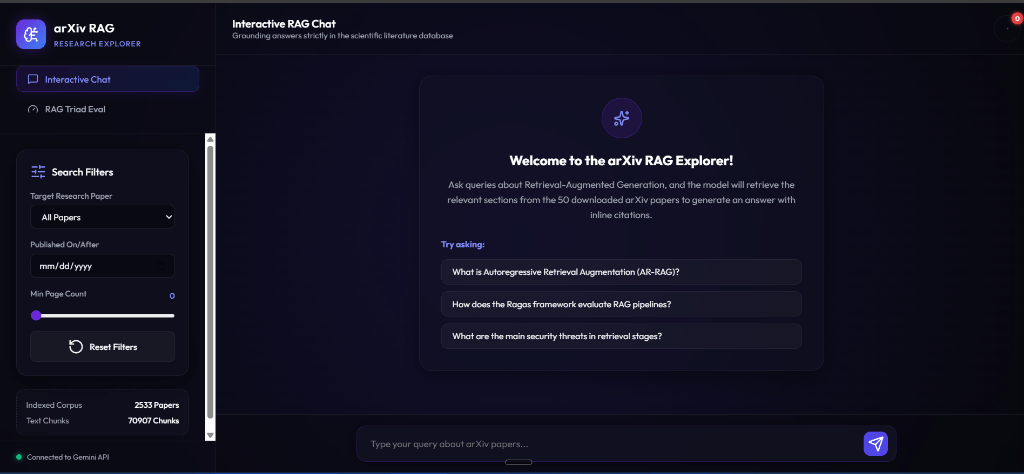
arXiv Research RAG is a research-focused retrieval-augmented generation engine built to answer questions strictly grounded in indexed academic literature, with a principled refusal system that aborts generation when evidence is insufficient.
Highlights
Hybrid Retrieval Pipeline
Dense vector search (Chroma DB + Gemini embeddings) blended with sparse BM25 (SQLite FTS5 inverted index) via Reciprocal Rank Fusion (RRF), then cross-encoder reranked by a local Sentence-Transformers ms-marco model.
Zero-Hallucination Refusal Ladder
A two-rung confidence gate aborts LLM generation when the top reranker score falls below a calibrated 70% threshold, returning a structured refusal at $0 API cost.
Semantic Cache
Embedding-based query deduplication with cosine similarity — cache hits return in milliseconds with zero LLM calls, even for paraphrased queries.
MCP Live Fallback
When the local 2,500-paper corpus lacks coverage, the Model Context Protocol client queries arXiv and Semantic Scholar live, generates a grounded answer, and auto-ingests the new papers into Chroma DB in the background.
Parent-Child Chunking
Child chunks are retrieved, but full parent-window context is passed to the LLM, improving answer completeness without inflating index size.
Knowledge Graph
Co-citation and co-authorship graph stored in a disk-backed JSON registry for paper network exploration.
Built with
- Python
- FastAPI / Uvicorn
- Chroma DB
- SQLite FTS5
- Gemini Embeddings
- Sentence-Transformers
- MCP
- arXiv API
- RAG
- BM25 + RRF
- Semantic Cache
- PM2